On Comparing Your Life to Everyone Else's

To my younger self, You look at everyone else and think their life is better. Their grades. Their friends. Their family. Their smile. You don't see what happens behind closed doors. You don't see the tears they cry at night or the questions they're too afraid to ask. Everyone is trying very hard. Everyone is trying to thrive in their own way. So here's what I need you to hear: Do not compare yourself to others. Not their success, not their pace, not their highlight reel. And when you do achieve something — don't make someone else feel small because of it. There is room for all of us to win. Life doesn't have to be a competition. Comparison is the thief of joy. But a win for you doesn't have to be a loss for someone else.

On Fear and Mistakes

To my younger self, You are so afraid of making mistakes. You replay conversations in your head. You avoid trying because failing feels like dying. I still struggle with this — even now, writing to you. But ask yourself: What would you do if you were not afraid. Mistakes are not the end. They are not proof that you're broken. They are proof that you tried. And here's the thing — there is no final exam in life. There is no "lesson" you either pass or fail. Everything is just a learning curve. You're allowed to be bad at things. You're allowed to fall. You're allowed to not know. You are not perfect. I am not perfect. No one is. So stop judging yourself so harshly — and stop judging others harshly too. You don't have the full picture. You never do.

On Speaking Up and Standing Tall

To my younger self, You're afraid of telling the truth. You're afraid of standing up for what's right. You swallow your voice because it feels safer to stay quiet. I get it. I still get it. But you maybe misunderstood. People may talk about you or have opinions about your life, your choices, your character — most of which have nothing to do with who you actually are. And in the end, you need to know what you want. You need to stand up for yourself and for the people you love. Not by fighting. Not by comparing. But by communicating — clearly, honestly, and with love. And when you're wrong? Learn to apologize. That's not weakness. That's strength.

On Being Alone and Being Present

To my younger self, You're always moody over small things. You don't want to talk. You retreat into yourself and call it peace. I see you. But here's what I wish you knew: You can be surrounded by people and still feel completely alone. So learn to be alone — truly alone — without running from yourself. That's the only way you'll ever be good company for anyone else. And when you're with people? Be with them. Not in your head. Not in the past. Not in the future. Right there. In the moment. I know it's hard. It's still hard for me. But try anyway. That's all any of us can do.

On Letting Go and Moving Forward

To my younger self, You dwell. You replay. You hold onto things that have already passed, turning them over in your mind like stones you can't put down. Be forward-looking. The past is a place of reference, not residence. You can't change what happened. You can only decide what happens next. And sometimes — listen — sometimes in order to win, sometimes you have to lose. You have to let others have their moment. You have to release the need to always be right, always be first, always be seen. That's not defeat. That's wisdom.

On Boundaries, Kindness, and Knowing When to Walk Away

To my younger self, You are kind. I love that about you. But sometimes people will take advantage of that kindness. So learn this early: Know when to give, and know when to stop. Love yourself first — not out of selfishness but because you cannot pour from an empty cup. Be wise enough to say no. To turn things down. To walk away. And when someone disrespects you? Walk away. You don't have to fight. You don't have to explain. You don't even have to be rude. You can simply leave — and if you must, point the middle finger politely. (I'm joking. Mostly.)

On Family, Independence, and Respect

To my younger self, Not everyone is your parents. They don't owe you anything. The world will not love you the way your family does — and even your family's love is imperfect. So learn to stand on your own two feet. Have your own opinions. Build your own life. But while you do — respect and love them. You can be independent without being cold. You can disagree without being cruel. You can grow up without growing away.

On Light, Spirit, and Trying Again

To my younger self, Light attracts light. Protect your spirit. Make time for the things that feed your soul — prayer, stillness, nature, whatever brings you back to yourself. It doesn't have to be perfect. You don't have to be perfect. Just try. Sometimes you'll have an ego. Sometimes you'll be stubborn. That's okay. Be like a river — always moving forward, always flowing, never stuck in one place for too long. And keep this close: No one is perfect. Not you. Not them. You don't have the full picture — of anyone's life, including your own. So hold your judgments loosely, your love tightly, and your kindness generously.

Closing Note

To my younger self, I can't go back and tell you these things. I can't protect you from the lessons you'll have to learn on your own. But if somehow these words reach you — across time, across memory — I hope you know this: You were never behind. You were never too much. You were never not enough. You were just learning. And that's all any of us are ever doing. With love, You — but a little wiser, a little softer, and still trying.
For My Own/(Others) Insecurities 

To The Little Ones Who Struggle With Self Image Issues. 

We Are Imperfect Yet Special:

I am a boyish girl. I have my late dad’s jawline and a little of his features at the side. To make it “smaller and more feminine” would mean going under the knife to remove part of my bone—something I am terrified of. My eyes get comments that they are “slit”—narrow and small. It feels worse when I wake up in the morning, feel bored, or feel tired. They look half asleep. My body is naturally tanned. My hair is shorter than most boys’. Sometimes I get mistaken for a “he,” and most people find me very “bro”—a term for “brother” on our sunny island, Singapore.

My late grandfather, who used to worry about me, once commented that I should keep my hair long. Oddly, I looked for ready-made hair buns and ordered them, but I’m not sure how to use them. They look like a bird’s nest. However, the moment I style my hair to cover that jawline, I look a little more like a “she.” Then I don’t feel like a boy with lipstick. Or a boy with pearl earrings. My parents always wanted a boy, so I suppose I am the best of both worlds. The beauty standard of highly photoshopped individuals looking perfect and neat sometimes scares me. Do I need to spray myself tanned like orange, sun-kissed skin? Or make myself pale with the latest Korean spray, all the way up to my armpits? My boobs don’t seem perfectly balanced, and I wonder if it’s the same for most people. They don’t look like the round half-oranges you see in push-up ads. I am mostly Maybelline: not born with it. Occasionally, I look at others and notice what I lack—out of curiosity, not so much envy. I’m close to my 40s, yet this insecurity still creeps in. Sometimes it is loud. Sometimes it is not.

My headshot needs many takes—a real challenge for most photographers. As a kid, when I played sports, my anxious mum worried that I might hurt the boys. My hair is curly and often needs a trim; otherwise, I don’t know what to do with it. To keep it long, I need to have it straightened at the salon for hours, like a long plane ride. The kids I teach look at K-pop and influencers the way I used to stare at magazine covers. I hope they don’t end up like me, feeling insecure about their bodies. The need for full control. The need to cut their eyelids to feel perfect. The need to fit a certain mould to feel good. There are some who accept who I am, and I am grateful for them. Most of us don’t say, “I like your soul,” and impression counts. My late dad even once asked if I was gay. No, I am not. He had a theory that when women reach a certain age, some hormonal imbalance makes them act strangely—suggesting something not too healthy. I have a theory that I am creepy and unusual and not following the “norms.” In the end, I think everyone else is taken, and we should just be ourselves.

Do you know how rare it is to have found something you are genuinely good at and that the world actually needs? Most people spend decades looking for that. You've found it while you're still in school. That's not a small thing—that's a head start.

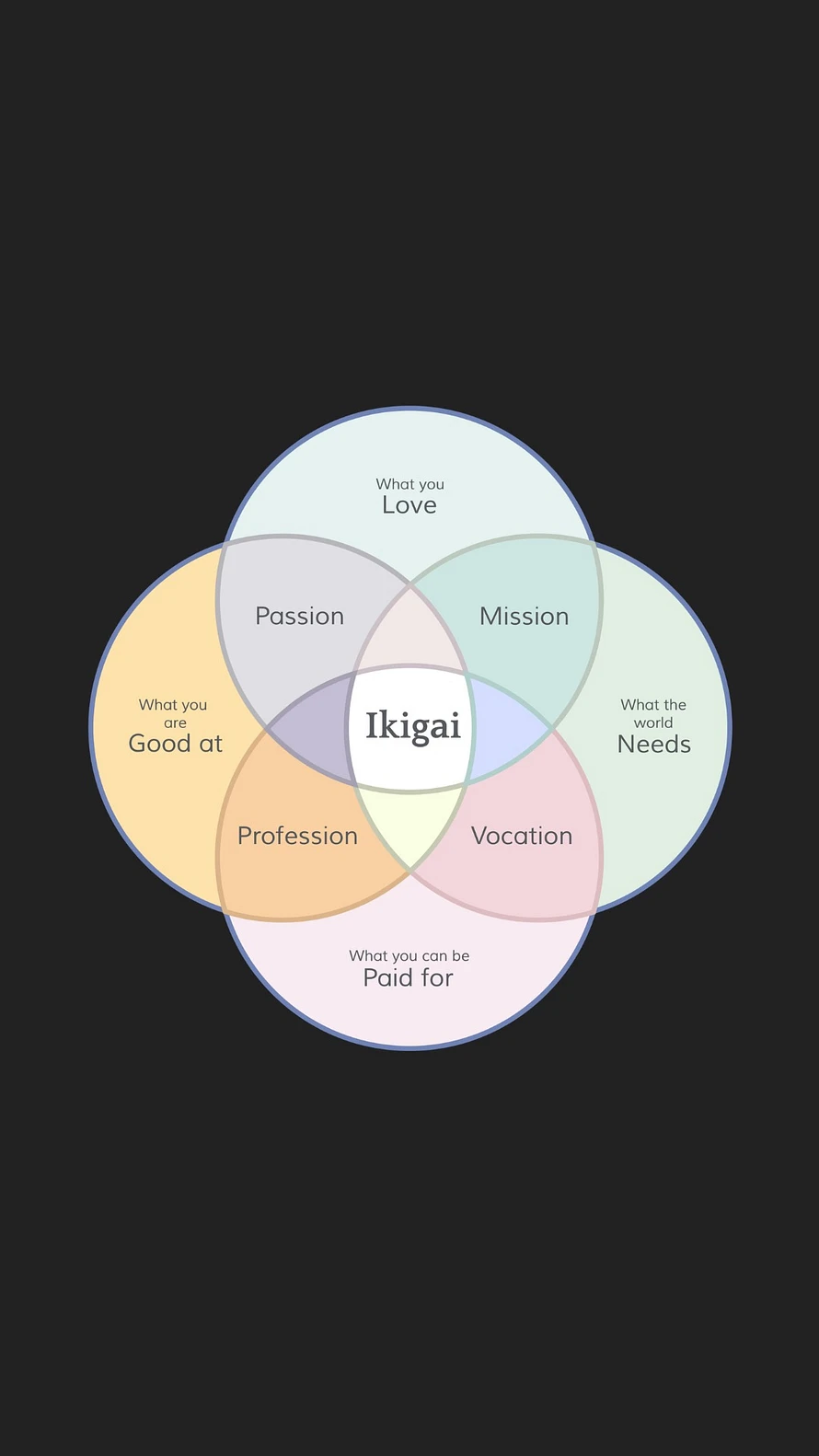
Ikigai is a beautiful concept. Ikigai (生き甲斐) is a Japanese concept that roughly translates to "a reason for being." It's usually shown as four overlapping circles:

  • What you love (Passion)
  • What you're good at (Vocation/Profession)
  • What the world needs (Mission)
  • What you can be paid for (Profession/Vocation)
  • Where all four overlap = Ikigai.

What You Love (Passion): The things that bring you joy, curiosity, and energy. For you, this might be nature, creativity, or working with your mum on projects.

What You're Good At (Vocation): Your skills, talents, and strengths. Maybe it's explaining things clearly, designing promo materials, or organizing.

What the World Needs (Mission): The problems you care about solving. This is where global warming, waste, and sustainabilitycome in. The world needs people who care and act.

What You Can Be Paid For (Profession): The practical side—how you earn a living or sustain your work. Your promo business, recycle bags, or future career.

Passion: You care about the planet. Mission: The world needs people to fight climate change. Profession: You can build a business around sustainable products. Vocation: Your recycle bags and eco-friendly promos help the world and sustain you.

Average grades don't mean you're average. They mean school isn't your strongest arena—and that's okay. School rewards certain type of intelligence: memorization, sitting still, following structure. Web design rewards a different type: creativity, problem-solving, visual thinking, persistence. Both are real. Yours just doesn't show up on a report card the same way.

You've found your ikigai. That's the hard part. Now just don't let school convince you it's not valuable—because it is. Keep your grades passing, keep building your skill, and keep going. In five years, no one will ask what you got in math. They'll ask what you can build. School teaches you to finish things. Your ikigai teaches you why it matters. You need both—but only one of them is your future.

Why is global warming happening?
The Earth naturally traps some heat to keep us warm. But by burning coal, oil, and gas, humans have added extra greenhouse gases that trap too much heat. It's like putting ten blankets on the planet instead of one. The result: rising temperatures, extreme weather, and a changing climate.

The Earth has a natural "blanket" of gases in the atmosphere that traps some of the sun's heat. This is called the greenhouse effect, and without it, Earth would be about 33°C colder—a frozen ball of ice. So the greenhouse effect itself is a good thing. The problem is we've made that blanket too thick.

Sunlight comes in: Energy from the sun travels to Earth as light. Some is reflected back to space, but most is absorbed by the land and oceans, warming the planet.

The Earth radiates heat back out: The warmed Earth releases that energy back toward space as infrared (heat) radiation.

Greenhouse gases trap the heat: Gases like carbon dioxide (CO₂), methane (CH₄), and nitrous oxide (N₂O) absorb that outgoing heat and re-radiate it in all directions—including back down to Earth. That's the greenhouse effect.

Humans thickened the blanket: Since the Industrial Revolution (~1850), burning fossil fuels (coal, oil, gas) has released huge amounts of CO₂ that were buried underground for millions of years. We also added methane from agriculture and landfills, and nitrous oxide from fertilizers.

The balance tipped: More greenhouse gases = more heat trapped = the planet warms. That's global warming. Climate change is the knock-on effect: shifting weather patterns, rising seas, extreme events.

International Committee of the Red Cross

The ICRC is a neutral, impartial and independent humanitarian organization.

The ICRC is part of the International Red Cross and Red Crescent Movement. The ICRC works closely to ensure an efficient and rapid response to conflict or violence. ICRC is the largest humanitarian network in the world. The Red Cross is a humanitarian organisation established to relieving human suffering, protecting lives and responding to emergencies. It serves vulnerable communities through various programmes, including services for the disabled, elderly aid, transport assistance, and community first aid. Red Cross ensure a safe and sufficient blood supply for all patients in Singapore. The Singapore Red Cross is Important for Blood Donation: It Secures the Nation's Blood Supply. Promoting the public on the importance of blood donation. Organising mobile blood donation drives across the community.

It Responds to Critical Shortages: Blood has a short shelf life — six weeks for red cells and only seven days for platelets making regular donations essential. Red Cross actively monitors blood stock levels and issues public appeals when supplies run low. It Saves Lives Across Medical Needs: Blood is essential for: Surgeries (including trauma and heart surgery). General medicine. Haematology (blood diseases like thalassaemia and leukaemia). Oncology (cancer patients). Obstetrics and Gynaecology. One unit of blood can save up to three lives.

It Builds a Culture of Regular, Voluntary Donation: Only 4 in 10 donors donate more than once a year, which is insufficient for a stable blood supply. The blood donation is a shared responsibility and an essential component of community resilience. 

How You Can Help: Red Cross encourages everyone who is eligible to donate blood regularly — at least twice a year. Every donation is a lifeline for someone undergoing surgery, fighting cancer, or living with a blood disorder. You can also become a blood donation advocate, volunteer at blood drives, or encourage your workplace to adopt a Bloodbank.

Why we share our basic notes on well being: This is because access to professional mental health support, like therapy and counselling, can be limited by cost, availability, and stigma. Yet, everyone experiences emotional challenges. By sharing simple, evidence-based techniques, we can: democratize well being: to provide free, accessible tools for emotional management that anyone can try. Hopefully these equip others with immediate strategies to navigate difficult moments, reducing overwhelm. These practices are not just for crises; they build resilience and foster positivity, helping to prevent smaller issues from growing. While these notes are not a replacement for professional help for serious conditions, they are a powerful step toward collective well-being. Sharing knowledge is an act of care - it helps build a community that is more informed, empathetic, and resilient.

A Practical Guide to Managing Emotions & Cultivating Well-Being

This guide combines timeless wisdom with modern psychology to help you navigate your emotional world and build a more fulfilling life. Feel free to share these techniques with anyone who might benefit. We share this basic ways to deal with difficult emotions as we know - more and more people seem to need these and sometimes 

Part 1: Managing Difficult Emotions

These are tools for the tough moments—when you feel overwhelmed by anger, anxiety, sadness, or stress.

1. Name It to Tame It:

What it is: Simply label the emotion you are feeling without judgment. Instead of "I am angry," try "I feel anger" or "I am noticing a feeling of anxiety." and try to identify the source of why. Why it works: This creates a small gap between you and the emotion, reducing its intensity and making it feel more manageable. Our emotions are here to tell us something. 

2. The P.A.U.S.E. Method:

P: Pause: Stop what you are doing. Take a literal break.

A: Acknowledge: Notice what you are feeling in your body: For instance: My jaw is clenched or my stomach is tight.

U: Understand: Ask yourself - What is this emotion trying to tell me? What need isnot being met"

S: Shift: Take one action to shift your state. This could be a deep breath, stepping outside, or drinking a glass of water.

E: Engage Again: Re-engage with the situation or person from a calmer, more centered place.

3. Deep Breathing (The 4-7-8 Technique):

How to do it: Inhale quietly through your nose for 4 seconds. Hold your breath for 7 seconds. Exhale completely through your mouth for 8 seconds. Repeat 3-4 times.

Why it works: It activates your parasympathetic nervous system, which counteracts the "fight-or-flight" stress response.

4. The 5-4-3-2-1 Grounding Technique:

How to do it: When feeling anxious or disconnected, engage your senses:

Name 5 things you can see.

Name 4 things you can feel such as the chair under you or your feet on the floor.

Name 3 things you can hear.

Name 2 things you can smell.

Name 1 thing you can taste.

Why it works: It pulls your focus away from racing thoughts and into the present moment.

5. Cognitive Reframing:

What it is: Challenge and change negative thought patterns. Ask yourself:

"Is this thought absolutely true?"

"What is another way to look at this situation?"

"What would I tell a friend who had this thought?"

Why it works: Our emotions are driven by our thoughts. Changing the thought often changes the feeling.

6. Healthy Emotional Expression:

Journaling: Write freely about your feelings. The goal is not to create a masterpiece but to process and release the emotion.

Talk to a Trusted Person: Verbalizing feelings can provide relief, support, and a new perspective.

Creative Outlet: Use art, music, dance, or any creative act to express what words cannot.

Part 2: Building Positive Emotions (Positive Psychology)

These are practices to proactively build resilience, joy, and meaning into your life.

1. Practice Gratitude:

The 3 Good Things Exercise: Each day, write down three specific things that went well and why they happened. They can be small such as "The sun felt warm on my walk" or large "I got a promotion because of my hard work"

Gratitude Letter: Write a letter to someone you are thankful for, detailing what they did and how it impacted your life. For an even bigger boost, deliver and read it to them in person.

2. Savoring:

What it is: The art of intentionally intensifying and prolonging positive experiences.

How to do it: When something good happens, pause. Absorb it fully. Engage all your senses. Share the moment with someone else. Reminisce about it later. Anticipate future positive events.

3. Acts of Kindness:

What it is: Doing something helpful or generous for others without expecting anything in return.

Why it works: It boosts the giver's mood as much as the receiver's. It creates connection and a sense of purpose. It can be as simple as a compliment, letting someone go ahead in line, or buying a coffee for a colleague.

4. Identify and Use Your Character Strengths:

What it is: Positive psychology identifies 24 universal character strengths (e.g., curiosity, kindness, perseverance, love of learning, humor).

How to do it: Take the free VIA Survey (viacharacter.org) to discover your top strengths. Then, find one new way to use one of your top strengths each day. Using your strengths is a key to engagement and flow.

5. Cultivate Optimism:

Best Possible Self Exercise: Spend 10-15 minutes writing about your life in the future, imagining that everything has gone as well as it possibly could. Be detailed. This exercise helps build hope and identifies goals that are deeply meaningful to you.

6. Nurture Social Connections:

What it is: Strong social relationships are the single biggest predictor of happiness.

How to do it: Prioritize face-to-face time with people who uplift you. Put away your phone during conversations. Be vulnerable and share your authentic self. Join a club or group centered on a shared interest.

7. Mindfulness and Meditation:

What it is: Training your attention to be in the present moment without judgment.

How to start: Just 5-10 minutes a day using a guided app (like Insight Timer, Calm, or Headspace) can reduce stress, improve focus, and increase emotional regulation.

8. Find Flow:

What it is: The state of being so immersed in an activity that you lose track of time. It usually happens when a challenge slightly exceeds your skill level.

How to find it: Engage in activities you love that are challenging yet achievable. This could be playing an instrument, a sport, coding, writing, or gardening.

How to Share This Guide

You are welcome to share this list verbatim or adapt it to your needs. Here are a few ideas:

Post it on social media in a series of posts or a downloadable graphic.

Print it out and leave copies in community centers, libraries, or coffee shops.

Use it as a discussion guide for a group or workshop.

Pick one technique a week to practice and share your experiences with friends.

A Final Note of Encouragement:

Well-being is a practice, not a destination. You don't need to do all of these at once. Pick one or two that resonate with you and try them for a week. Be kind and patient with yourself. Small, consistent steps lead to profound change.

Racial harmony in Singapore is not a grand monument. It is a hawker centre at lunchtime. It is a game of chapteh in the schoolyard. It is a plate of noodles shared between friends who look different but laugh the same. The tapestry is woven not in parliaments, but in everyday moments—and every thread matters.

Everyday Bridges

A bowl of laksa: A dish born from Chinese and Malay cultures—proof that blending creates something delicious.

A Good Morning Towel: Carried by labourers of all races who built Singapore together.

Chapteh / Congkak: Games that don't need a common language—just a shared willingness to play.

Where a Chinese uncle, a Malay auntie, and an Indian family can share the same space and the same meal.

Chinese Singaporeans

  • Unique area: Chinatown — temples, clan associations, heritage shophouses, and traditional medicine halls.
  • Festivals: Chinese New Year, Mid-Autumn Festival, Qingming.
  • Everyday culture: Reunion dinners, yu sheng (lohei), mooncakes, tea traditions, dialect groups such as Hokkien, Teochew, Cantonese, Hakka, Hainanese. Bridge moment: Chinese New Year is now celebrated by many non-Chinese Singaporeans too, who join in lohei and exchange greetings.

Malay Singaporeans

  • Unique area: Kampong Glam — Sultan Mosque, Arab Street, traditional textile and perfume shops. Festivals: Hari Raya Puasa, Hari Raya Haji.
  • Everyday culture: Kampong spirit, gotong royong (community mutual help), strong family and neighbourly ties.
  • Food: Satay, rendang, ketupat, lontong, mee rebus, kuih. Bridge moment: Malay food is loved across all races; satay stalls and nasi padang shops are common meeting places.

Indian Singaporeans

Unique area: Little India — Tekka Centre, Sri Veeramakaliamman Temple, flower garlands, spice shops. Festivals: Deepavali, Pongal, Thaipusam. Everyday culture: Colourful textiles, classical music and dance, religious processions.Food: Thosai, idli, prata, biryani, vadai, teh tarik. Bridge moment: Indian-Muslim food like prata and teh tarik is eaten at all hours by all communities.

Eurasians

Unique area: Holland Village and parts of Katong have Eurasian heritage connections. Festivals: Christmas, Easter, and family feast days. Everyday culture: A blend of European and Asian traditions — in language, music, food, and religion. Food: Curry debal, shepherd’s pie, sugee cake. Bridge moment: Eurasian culture itself is a living bridge between East and West.

Peranakans

(Nyonya and Baba)

Unique area: Katong and Joo Chiat — Peranakan shophouses, kebaya shops, and nyonya restaurants. Festivals: Chinese New Year, but with distinctive Peranakan rituals. Everyday culture: Kebaya, beaded slippers, porcelain, language mixing, and elaborate nyonya kueh. Food: Laksa, ayam buah keluak, bakwan kepiting, kueh chang. Bridge moment: Peranakan culture is itself a fusion of Chinese, Malay, and Indonesian influences — proof that cultures can blend and create something new.

Shared Everyday Spaces

  • The real harmony is not only in heritage districts.
  • It is in: Hawker centres where everyone queues for the same food.
  • HDB estates where neighbours of different races live side by side.
  • Schools where children play chapteh, congkak, and football together.
  • MRT trains and buses where strangers share the same daily journey.

Racial harmony in Singapore is not a grand monument. It is a hawker centre at lunchtime. It is a game in the schoolyard. It is a plate of noodles shared between friends who look different but laugh the same. The tapestry is woven not only in parliaments or textbooks, but in everyday moments — and every thread matters.

"Harmony isn't taught from a textbook. It's woven at the table, in the playground, and through the everyday things we share."

By Bemusedcreative & The Ai Assistant

This was a hugely popular 2009 Indian film 3 Idiots.

I still remembered one of my aunts took me to the movies for that while I was struggling to have one of my exams back then while I was working. The main phrase "All is well" stays with me even now.

It is one of its most famous and beloved line.It's meaning is revealed through a simple but profound story:There was a security guard at his old housing complex who would patrol at night, chanting "All is well."

This chant gave all the residents peace of mind, allowing them to sleep soundly. However, one night, a thief broke in. It turned out the guard was actually night blind and could not see the thief at all.

The Real Lesson: It points out that the chant did not actually solve the problem but the human heart is easily frightened and needs reassurance. "All is well" is not a magical solution to make problems disappear. 

Instead, it is a trick to calm your mind and give you the courage to face the problem and solve it yourself. It is a tool for managing fear and stress. Besides that, the film contrasts the passion-d riven approach to learning with the college competitive, and memory-based system, embodied by the tyrannical director, Viru (nicknamed "Virus".Pursuing

Passion vs. Societal Pressure: Farhan is forced into engineering by his father, despite his dream of becoming a wildlife photographer. Raju is crippled by the fear of failing his family, who have pinned all their hopes on his engineering degree to lift them out of poverty.

Mental Health and Student: The movie bravely addresses the immense pressure on students, which can have tragic consequences by the system that created unbearable stress.Ultimately, the film's message, summed up by "All is well," is about resilience. 

By Beaconlearners & Our Ai Assistant

Book Recycling Program

There are several meaningful ways for kids in Singapore to recycle books, supporting both local communities and children in other countries. You can find everything from annual donation drives and convenient drop-off points to organized efforts that send books overseas.

A Quick Note on Book Condition

Before donating, please ensure all books are in good, clean condition (no missing pages, scribbles, or damage). Most local programs only accept currently-used textbooks for the new school year, but storybooks are widely accepted elsewhere.

For Kids in Singapore (Local Donations)

These programs directly help underprivileged students, fund reading programs, or support social enterprises in Singapore.

Share-A-Textbook (FairPrice Group)

This is Singapore's largest textbook donation drive, running every November. It collects gently-used, current syllabus textbooksand distributes them for free to needy students. You can drop books off at any FairPrice Xtra outlet.

Read for Books (NLB)

A signature charity book drive by the National Library Board. While it's a "read-a-thon" (you read to trigger donations), it's a great way to teach kids about giving. Recent beneficiaries include kidsREAD and MINDS.

Thryft (Books for Charity)

An online secondhand bookstore. You can donate books to their "Books for Charity" collection or trade them in for credits. 50% of the profits go to their charity partners, making it a sustainable cycle of giving.

Dignity Mama Stalls

Run by Project Dignity, these stalls sell second-hand books managed by young adults with special needs and their parents. Your donations directly support the training and empowerment of these youth.

City Square Mall Children's Book Donation Drive

Look out for their periodic drives. Donated children's books stock the Jalan Besar Community Club Library Corner, helping kids in the neighbourhood enjoy more pre-loved books.

Share At Door Step

For a small transport fee (from $19), they will collect books right from your home and deliver them to verified charity partners. This is perfect for busy families with large volumes of books.

Australian International School (AIS) Initiatives

While not open to the public daily, AIS sometimes runs book drives (like the one for Cambodia). It's a good example of how school communities can band together to support international libraries.

For Kids in Third World Countries (International Donations)

If you want your child's books to travel further, these initiatives ship books to developing nations to build libraries and improve literacy. Usually, these programs partner with logistics companies to handle the heavy lifting.

Singapore Government to Laos (2025)

The National Library Board of Singapore curated a donation of 500 English children's books to the National Library of Laos to support youth empowerment and English learning.

Ocean Network Express (ONE) to South Africa (2025)

Working with Sony Singapore and schools, 11,500 books were shipped for free to stock mobile libraries for children in rural South Africa. It shows that corporate partners can facilitate large-scale giving.

Tips for a Successful Donation

Sort First: Separate storybooks from textbooks. Check if textbooks are still on the Ministry of Education's approved list before donating to local drive.

Check Dates:

For drives like Share-A-Textbook, collection is strictly during the November window. Plan to declutter around October/November.

Clean Covers:

Wipe down books to make them feel new and respected for the next child.